Why Is My Website Traffic Dropping Even Though My Google Rankings Are Stable?
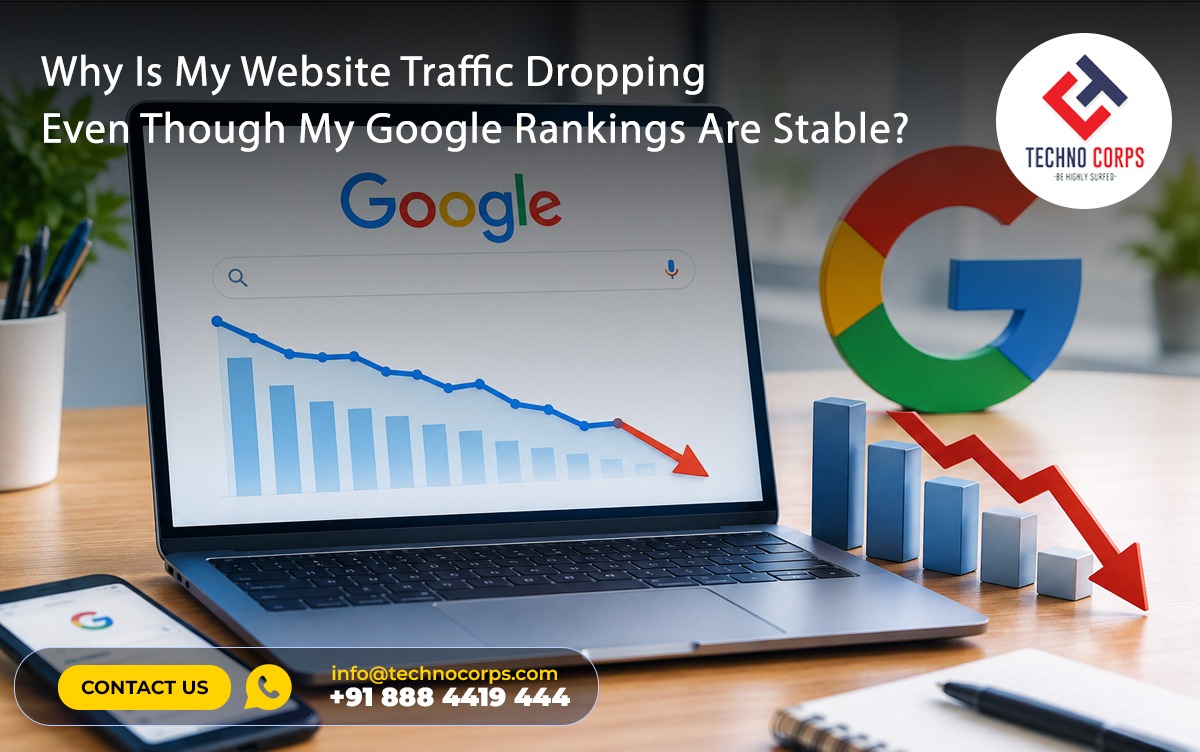
If you've checked Google Search Console and your keyword positions look fine — maybe even improved — but your sessions keep sliding, you're not misreading your dashboard, and you likely haven't been hit by a penalty. This is one of the most common patterns businesses are seeing in 2026, and it has a specific, structural cause: rankings measure position, not clicks, and a growing share of searches now end before a click ever happens.
The Short Answer: Your Rankings and Your Clicks Are Not the Same Metric
A keyword ranking tells you where your page sits on the results page. It says nothing about how many people actually click through to your site. For most of SEO's history, those two numbers moved together closely enough that “rankings” became shorthand for “traffic.” That link has broken.
Google now answers a large share of queries directly on the results page — through AI Overviews, AI Mode, featured snippets, local packs, and other on-SERP features — before the user ever reaches a website. Multiple 2026 industry studies put the overall zero-click rate (searches that end with no click to any external site) at roughly 60–65%, and mobile zero-click behavior is even higher. When an AI Overview appears above your listing, independent research has found organic click-through rate on the first result can fall by roughly half, even when that result hasn't moved.
In other words: your position held. The click didn't.
How to Confirm This Is What's Happening to You
Before changing anything on your site, diagnose the cause. Reacting to a structural shift as if it were a technical problem wastes effort; treating a real technical regression as “just AI Overviews” lets an actual fixable issue go unaddressed.
- Open Google Search Console → Performance report.
- Compare Impressions and Clicks over the last 3–6 months, filtered by your key landing pages.
- Look for the specific pattern: impressions flat or rising, clicks falling, average position stable or improving. That combination points to CTR loss, not a ranking or indexing problem.
- Check the Search appearance filter for "AI Overview" / "AI features" where available, and compare CTR on queries with and without that feature present.
- Rule out the boring causes first: no manual action in Search Console, no sudden indexing drop, no broken tracking code, no seasonal dip you'd normally expect for your industry.
If impressions are holding but clicks aren't, the cause is very likely on the SERP itself, not on your site.
The Main Reasons Traffic Falls While Rankings Stay Flat
1. AI Overviews and AI Mode Are Absorbing the Click
When Google generates an AI-written answer above the organic results, a meaningful share of users get what they need without clicking anything. Your page may even be one of the sources the AI Overview drew from — you're still influencing the answer, but that influence often doesn't show up as a session in your analytics.
For a closer look at how this shift is playing out, see our research on AI Overviews vs traditional SEO.
2. Rising Zero-Click Search Generally
This trend predates generative AI — featured snippets, knowledge panels, and direct answer boxes have been growing for years. AI features have accelerated it, but it isn't a single event you can point to and fix; it's a gradual redistribution of where users get their answer.
3. Search Demand or Seasonality Has Shifted
Sometimes the query volume for your target terms has genuinely dropped, independent of anything AI-related. Check Google Trends and your impression totals over a longer window before assuming the cause is AI-driven.
4. SERP Layout Changes on Your Specific Queries
Video carousels, local packs, shopping modules, "people also ask" expansion, and other layout additions can all push organic results further down the page or reduce their visual prominence, even while your ranked position number stays the same.
5. Cannibalization or a New Competing Page
If a newer page on your own site (or a heavily updated competitor page) is now capturing clicks for the same query, your Search Console numbers per-URL will show the redistribution even if your domain's overall ranking looks stable in a rank tracker.
6. A Genuine Technical Regression, Hiding Behind Stable Rankings
Slower page speed, a broken internal link path, an accidental noindex on a related page, or an analytics/tagging issue can all suppress traffic without moving your tracked keyword positions. This is the one cause worth ruling out carefully, since it's the one entirely within your control.
What Businesses Should Actually Do About It
- Stop treating ranking position as the finish line — track the full chain: impressions → clicks → leads → revenue.
- Prioritize content that AI Overviews and AI Mode tend to cite rather than fully answer on-page — comparisons, original data, pricing detail, and decision-stage content that a summary can't fully substitute for.
- Strengthen the pages built for people ready to act, not just people researching — those clicks are holding up far better than broad informational queries.
- Keep investing in the fundamentals that make you eligible to be cited at all: crawlability, topical authority, clear expertise, and structured data.
- Diversify demand generation so organic search isn't the only channel absorbing this shift — paid search, email, and social all still send clicks that don't pass through an AI summary first.
- Report on this properly. Separating "AI Overview / zero-click impact" from "actual technical regressions" in your reporting keeps you focused on what you can actually influence.
If you want to go further, our Generative Engine Optimization (GEO) guide covers how to build for exactly this kind of eligibility.
Not sure where your biggest leak is — impressions, clicks, or something on-site? Talk to us and we'll help you find it.