Google AI Mode SEO: How to Get Your Business Featured in AI Search Results in 2026
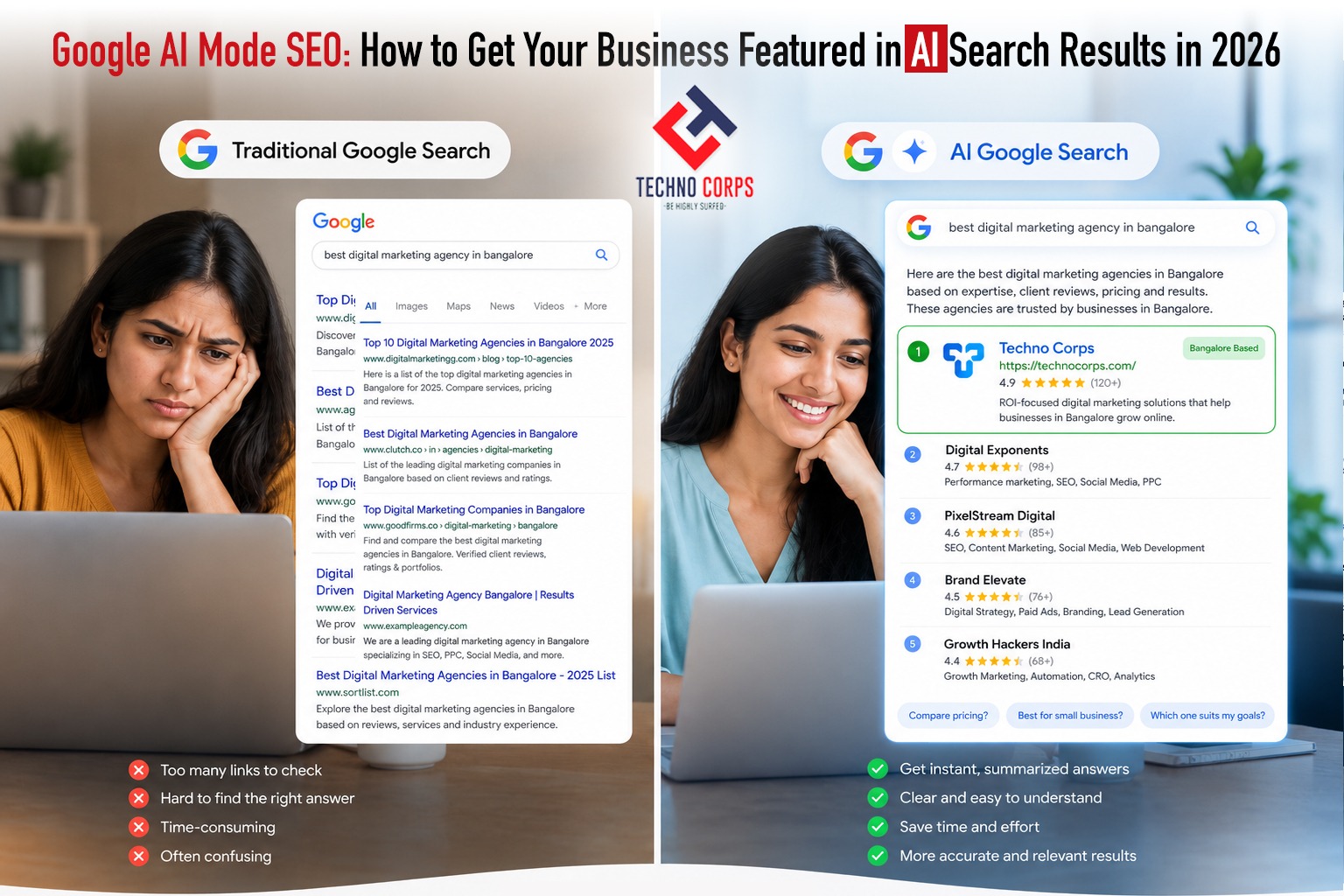
A business can hold the #1 organic ranking for its most valuable keyword and still be invisible where a growing share of buyers are actually looking. That's the uncomfortable reality of search in 2026. Google AI Mode now answers many queries directly inside a conversational interface, often before a user ever scrolls to a traditional results list. For businesses that have spent years optimizing for the ten blue links, Google AI Mode SEO has become a second, parallel visibility challenge — one that runs on different mechanics than classic ranking factors alone. Traditional rankings still matter. They're just no longer the whole game.
What Is Google AI Mode?
Google AI Mode is a conversational search experience built into Google Search, sitting alongside the familiar All, Images, and News tabs. Instead of returning a ranked list of links, it generates a synthesized, cited answer built from information gathered across the web, and it lets users ask follow-up questions within the same session.
The mechanism that makes this possible is called query fan-out. Rather than matching a single query to a single set of indexed pages, AI Mode breaks a longer, more complex question into several smaller sub-questions, runs them as parallel searches, and then weaves the retrieved information into one coherent response with supporting links.
Consider the difference between how someone might search before and after AI Mode:
- Traditional search query: "SEO company in Bangalore"
- AI Mode-style query: "What should a Bangalore technology company look for when choosing an SEO agency to generate B2B leads in 2026?"
The second query doesn't map neatly to one landing page. AI Mode may fan it out into sub-questions about agency vetting criteria, B2B lead-generation tactics, local SEO considerations, and pricing models — then pull passages from multiple sources to construct its answer. A website only earns a place in that answer if it clearly and directly addresses one or more of those underlying sub-questions.
Why Google AI Mode SEO Matters for Businesses in 2026
Search behavior has shifted. People increasingly type or speak longer, more conversational questions rather than short keyword fragments, and they expect a direct answer rather than a list of options to click through. When Google's AI systems generate that answer, they cite a limited set of sources — which means brand visibility now depends partly on whether a business's content is chosen as one of those references.
This doesn't diminish the importance of conventional ranking signals. If anything, it raises the bar. Websites still need strong technical SEO, relevant backlinks, and solid on-page optimization to be crawled, indexed, and considered a credible source in the first place. What's new is the added layer: content also needs to demonstrate clear topical authority, answer specific sub-questions in an extractable way, and reinforce strong entity signals so Google's systems can confidently associate a brand with a subject area. Businesses that treat AI search visibility as an extension of good SEO — not a replacement for it — are best positioned for 2026 and beyond.
How Google AI Mode Selects or References Websites
Google has not published a formula for how AI Mode chooses which sources to cite, and any claim to have "cracked" that algorithm should be treated with skepticism. What Google's own documentation does confirm is that AI Mode and AI Overviews rely on established Search ranking systems and quality signals as a foundation, then layer additional retrieval on top for generative responses.
In practice, this means the fundamentals still apply:
- Relevance to the searcher's intent
- Genuinely helpful, original content
- Demonstrated expertise and trustworthiness
- Topical authority across a subject area
- A crawlable, indexable, well-structured website
- Clear internal linking that connects related content
- Structured data that helps machines understand context
- Consistent, recognizable brand and entity signals
There is no guaranteed method to force Google AI Mode to cite a specific website. Any agency or tool promising guaranteed AI citations is overstating what's currently possible.
10 Google AI Mode SEO Strategies for Businesses
1. Create People-First Content
Write for the person asking the question, not for a search engine's crawler. Content that genuinely solves a problem is more likely to contain the extractable, specific statements AI systems look for.
2. Build Topical Authority
Cover a subject in depth through connected pillar and cluster content, for example: SEO → AI SEO → Google AI Mode SEO → AI Overviews → GEO → AEO → Semantic SEO. This structure signals comprehensive expertise rather than one-off coverage.
3. Answer Complex Search Queries
Since AI Mode fans a question into several sub-queries, a single well-structured page that addresses multiple related angles has a better chance of matching one of those sub-searches.
4. Target Conversational and Long-Tail Queries
Instead of writing only for "SEO agency Bangalore," also address phrasing like "how do I evaluate an SEO agency for B2B lead generation."
5. Strengthen Internal Linking
Contextual links between related articles help both users and Google's systems understand how topics connect across a site.
6. Add Original Experience and Expertise
Case studies, original data, first-hand screenshots, and expert commentary are harder to replicate and signal genuine E-E-A-T.
7. Strengthen Brand and Entity Signals
A clear About page, consistent organization details, named authors, and credible third-party mentions help Google recognize a business as a distinct, trustworthy entity.
8. Implement Structured Data Correctly
Organization, Article, BreadcrumbList, LocalBusiness, Service, and FAQPage schema (where genuinely applicable) help machines parse a page's content. Schema does not guarantee AI Mode visibility — it simply removes ambiguity.
9. Improve Technical SEO
Crawlability, a clean XML sitemap, correct robots.txt rules, canonical tags, HTTPS, mobile usability, strong Core Web Vitals, and logical site architecture remain the foundation everything else is built on.
10. Keep Content Fresh and Original
Regularly update statistics, examples, screenshots, and recommendations so content continues to reflect current, accurate information.
Google AI Mode SEO vs SEO vs GEO vs AEO
| Strategy | Main Purpose | Focus |
|---|---|---|
| Traditional SEO | Organic rankings | Search engines |
| AEO | Direct answers | Question-based searches |
| GEO | Visibility in generative engines | AI-generated responses |
| Google AI Mode SEO | Visibility in Google's AI search experience | AI-powered Google Search |
These approaches overlap considerably rather than competing with each other. Traditional SEO remains the foundation each of the others builds on — none of them work well on a site with weak crawlability, thin content, or poor technical health.
Common Google AI Mode SEO Mistakes to Avoid
- Keyword stuffing instead of writing naturally
- Publishing low-value, unedited AI-generated content
- Creating thin FAQ sections with generic, shallow answers
- Ignoring traditional SEO fundamentals
- Assuming schema markup guarantees AI citations
- Neglecting internal links between related content
- Writing without demonstrating real expertise
- Making unrealistic promises about AI-search rankings
Google AI Mode SEO Checklist
- Site is fully crawlable and indexable
- Content matches genuine search intent
- Topical authority is built through content clusters
- Internal linking connects related pages
- Content is original, not templated or thin
- E-E-A-T signals are clearly demonstrated
- Entity and brand signals are consistent site-wide
- Structured data is implemented accurately
- Core technical SEO health is strong
- Content is reviewed and refreshed regularly
- AI-search visibility is monitored over time
How Technocorps Can Help Your Business With AI Search Optimization
Building visibility across both traditional Google Search and AI-powered search experiences requires the same disciplined approach: strong technical foundations, genuinely useful content, and clear entity signals. Technocorps' SEO services combine technical SEO audits, topical content strategy, and Generative Engine Optimization so businesses aren't optimizing for yesterday's search engine.
Our team works across content marketing, Google Ads and SEM, social media marketing, and website design and development to make sure a business's digital presence is fast, well-structured, and genuinely helpful — the qualities that support visibility whether a customer arrives through a classic ranking, an AI Overview, or an AI Mode conversation. We also help clients understand where they currently stand through our ongoing research on AI Overviews versus traditional SEO performance and AEO content structuring.
We don't promise guaranteed AI citations or guaranteed rankings — no one honestly can. What we do offer is a structured, transparent process for improving organic visibility, AI-search readiness, topical authority, and lead generation over time.
Want to improve your visibility across Google Search and AI-powered search? Talk to the Technocorps SEO team.
Frequently Asked Questions
Want to build a search strategy that works across both traditional Google Search and AI-powered search? Talk to the Technocorps SEO team.